Urgent Conversations: Athens – Antwerp

The exhibitions Urgent Conversations: Athens–Antwerp and Urgent Conversations: Antwerp – Athens are a collaboration between EMST and M HKA, a theoretical and visual dialogue, based on works from the collections of both museums, which includes more than 70 works structured in 22 topics.
28.04.2017 - 07.01.2018
M HKA, Museum van Hedendaagse Kunst Antwerpen - Leuvenstraat 32, 2000 Antwerpen
EMST, National Museum of Contemporary Art - Kallirrois Avenue & Amvr. Frantzi Str., Athens 11743
 Back
Back
Guillaume Bijl

Since the late 1970s, Guillaume Bijl has been creating large-scale installations that depict reality using found objects. With his visual realism, he played a pioneering role in the revival of the ready-made principle in the early 1980s. Bijl reveals to the public various aspects of our Western ‘civilisation’ and consumer society. Using exaggerated stereotypes, he constructs a kind of ‘archaeology of our time’ – in a tragicomic and alienating manner.
Searching for a form of expression that would enable the audience engagement, the young self-taught artist began creating projects on paper in the 1970s. The most significant of these are various ‘Project Pleasures’ and nine ‘Treatments’. This latter series examines social conventions and phenomena such as the church, the army, the education system, the holiday industry, sex, the business world and the daily lives of workers. In these paper-based installations, Bijl maps out a route, accompanied by a step-by-step plan, which guides the visitor from space to space along the life path of, for example, a soldier. These projects form the thematic and spatial foundation for his later body of work.
In 1979, Guillaume Bijl created his first installation, Autorijschool Z, at Ruimte Z, an alternative art space in Antwerp. The artist depicts what should not actually have happened: the gallery is transformed into an everyday commercial establishment – a driving school. In this lifelike setting, the artist provides chairs and benches for the students, a blackboard, educational panels featuring road signs, a model motorbike… In Autorijschool Z, three elements that would remain characteristic of his entire body of work can already be recognised: firstly, there is the interplay between fiction and reality, which creates a sense of alienation or confusion in the viewer. Secondly, Bijl offers a critique of a contemporary social phenomenon. And finally, the fact that the installation is situated within an art context ensures that every object is transformed into a sculpture, a visual image.
This driving school was the first in the series of Transformation Installations, which would go on to become a visual epic of social phenomena. Bijl has created installations in numerous museums and galleries, such as Atoomschuilkelder (Liège, 1985), Schietoefenbaan (Eindhoven, 1985), Caravan Show (Grenoble, 1989), Neuer Supermarkt (Basel, 1990; Frankfurt, 2002; Liverpool, 2002), Luchthaven Basel (1986), Futonwinkel (New York, 1989), Extra Hair Shop (Brussels, 2012), Hundesalon Bobby (Zurich, 2016), and so on. Sometimes the installations are activated as a Tableau Vivant during the opening or closing events. For example, visitors were able to go shopping in the supermarket or gamble in the casino.
In addition to these Transformation Installations, five other types of work can be distinguished in Bijl’s oeuvre.
In his Situation Installations, he creates a ‘fiction within reality’, usually in public spaces. For example, during Documenta 9 in Kassel in 1995, the artist mounted birds on rooftops and lampposts, whilst in 1989 he placed a ‘No Camping’ sign next to tents in a park.
His Compositions Trouvées are still lifes, fragments of reality: objects that appear to have been taken from an antique shop or a shop, or ‘lost corners’ – forgotten objects in forgotten corners.
The Sorry works can take various forms. They are compositions or installations with an absurd element, causing them to fall outside the realm of reality and verging on the surreal. One example that has since become iconic is a small bird’s nest from 1987 containing one red and two white billiard balls – a bizarre still life.
Under the theme of Cultural Tourism, Bijl creates installations that focus on mundane museums and mass tourism, such as Roman Street (Antwerp, 1994) or the installation Lederhosen Museum (Graz, 1998).
The Realistic Scenes form the final chapter in Bijl’s oeuvre. These are humorous, painted bronze sculptures in public spaces, each depicting a theatrical snapshot of reality: a young woman sticking her head through a canvas depicting the Mona Lisa (PXL Hasselt, 2017) or a magician keeping his assistant floating in the air (Europaplein, Amsterdam, 2014).
* Some biographies of Guillaume Bijl state that he worked as a set designer before embarking on his artistic career. However, this information is incorrect. Bijl never worked as a set designer. He did, however, undertake a short course in drama at the RITCS in Brussels (1969–1970). For an early biography of the artist: Bijl, Guillaume. Guillaume Bijl. 1980. Turnhout, De Warande Cultural Centre, p. 1.
Items
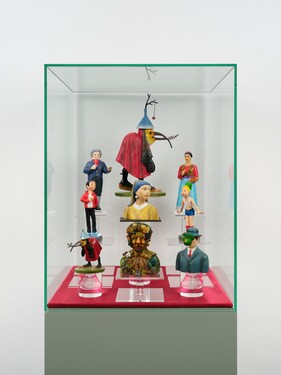
Sorry, 2024
Guillaume Bijl
Sorry (Paddestoelen), 2016
Guillaume Bijl
Sorry, 2014
Guillaume Bijl
Guillaume Bijl, 1996
Guillaume Bijl![TV-Quiz decor [TV Quiz Show Decor]](https://s3.amazonaws.com/mhka_ensembles_production/assets/public/000/009/710/medium_500/Bijl__Guillaume__TV-Quiz_Dekor__1993_foto_Syb%27l._S._-_Pictures.jpg?1340020484)
TV-Quiz decor [TV Quiz Show Decor], 1993
Guillaume Bijl
Composition Trouvée (à l'affiche / prochainement), 1993
Guillaume Bijl
Neuer Supermarkt, 1990
Guillaume Bijl
Guillaume Bijl - Passages - "An intro to creative visualization", 1989
Guillaume Bijl
Composition Trouvée (Rommelmarkt), 1988
Guillaume Bijl
Guillaume Bijl 'Four American Artists (Janet Fleisch, William Hall, Sam Roberts, Rick Tavares)', 1988
Guillaume Bijl![Mon Chalet [My Chalet]](https://s3.amazonaws.com/mhka_ensembles_production/assets/public/000/009/668/medium_500/Byl__Guillaume.jpg?1340009721)
Mon Chalet [My Chalet], 1987
Guillaume Bijl![235 Belangrijke en Minder Belangrijke Foto's van de 2de helft van de 20e Eeuw. [235 Important and Less Important Photos from the 2nd half of the 20th Century.]](https://s3.amazonaws.com/mhka_ensembles_production/assets/public/000/002/890/medium_500/Bijl,%20235%20belangrijke%20en%20minder%20belangrijke%20foto%27s%20%28detail%29p%5EhotoM%20HKAclinckx.jpg?1315232779)
235 Belangrijke en Minder Belangrijke Foto's van de 2de helft van de 20e Eeuw. [235 Important and Less Important Photos from the 2nd half of the 20th Century.], 1986
Guillaume Bijl
CHAUSSURES Icécé, 1980
Guillaume Bijl
CHAUSSURES Icécé, 1980
Guillaume Bijl
10 kleurenfoto’s van installaties, 1979
Guillaume Bijl![Autorijschool Z [Car - driving school Z]](http://s3.amazonaws.com/mhka_ensembles_production/assets/public/000/048/344/medium_500/Scan_Origineel_GB_Autorijschool_V3.jpg?1567156909)
Autorijschool Z [Car - driving school Z], 1979
Guillaume Bijl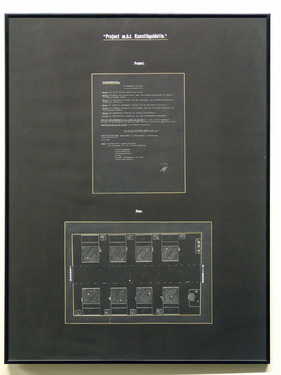
Project m.b.t. Kunstliquidatie, 1977
Guillaume Bijl![Projecten [Projects]](https://s3.amazonaws.com/mhka_ensembles_production/assets/public/000/000/805/medium_500/BK7591_A.jpg?1346354873)
Projecten [Projects], 1977
Guillaume Bijl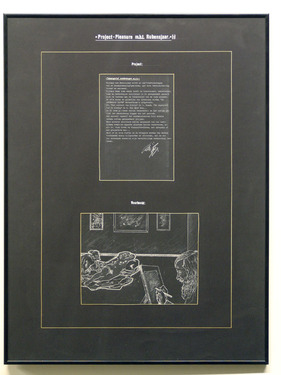
Project Pleasures, 1977
Guillaume Bijl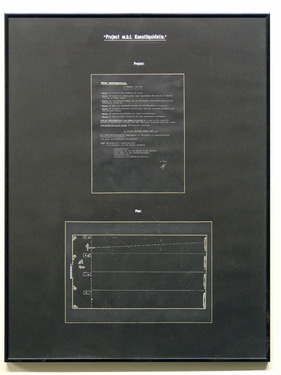
Project m.b.t. Kunstliquidatie, 1977
Guillaume Bijl
Behandelingen, 1975
Guillaume Bijl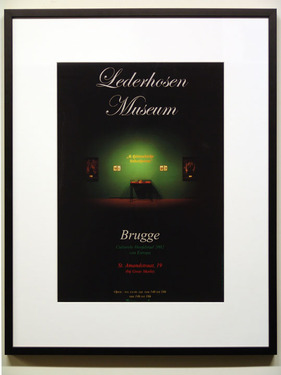
Affiches
Guillaume Bijl![Project - notities [Project Notes]](https://s3.amazonaws.com/mhka_ensembles_production/assets/public/000/012/288/medium_500/Afbeelding1.jpg?1346940124)
Project - notities [Project Notes], 1969
Guillaume Bijl
Back